


I spent most of last weekend somewhere with questionable cell service.
It was wonderful.
I didn’t realize quite how much I needed to disconnect until I was sitting in the back of a four-wheeler in northern New Hampshire, miles away from anything that particularly needed my attention.
There was no inbox to refresh. No notification asking for an answer. No analytics to peek at, contractor update to follow, renovation decision to make, or household task waiting one room away.
For a couple of days, there wasn’t much point in reaching for my phone at all.
And lately, I’ve been reaching for it a lot.
The internet always has something new to look at. Work has notifications. Home has projects. Every unfinished thing offers a reason to check, adjust, research, or plan. There is an endless stream of small things asking for a little bit of attention, and individually, none of them feels especially demanding.
Together, though, they make it surprisingly difficult to ever feel completely off.
Taking time off isn’t always the same as disconnecting
I can stop working without actually leaving work.
I can close the laptop and still check my inbox from the couch. I can watch television while looking at notifications, checking whether something changed, or mentally reorganizing Monday’s list.
Technically, that is time off.
My body may have left the desk. My attention hasn't.
My instinct when something is uncertain, or simply unfinished, is to get closer to it. I research. I organize. I plan. I make a spreadsheet, build a system, identify the next solvable piece, and start solving it.
Those instincts have served me well. They are a large part of how I work, how I navigate complicated projects, and how I create some structure when the outcome itself is beyond my control.
The problem is that those strengths don’t automatically know when they’re off the clock.
They don’t look at a Saturday afternoon and say, We’ve done enough for today. They say, There is probably one more useful thing we could do.
And usually, they’re right.
There probably is another useful thing I could do. There almost always is.
That doesn't mean it should get my attention.
A considerably smaller world
On Friday, I closed the laptop and went north. Way north.
My partner and I had plans with friends at a cabin in northern New Hampshire, and for a couple of days, my world got considerably smaller: a four-wheeler, a lake, a thousand-piece puzzle that somehow didn’t result in anyone getting murdered, too much coffee, beautiful views, and questionable cell service.
We spent hours riding through the mountains, packed into the four-wheeler with friends and taking in the scenery as we went. Back at the cabin, a rotating cast of people became far too invested in the puzzle spread across the table.
At night, the moon reflected across the lake.
In the morning, my partner and some of our friends left for a hike at an hour I continue to believe should be illegal on vacation. I stayed behind with coffee and my iPad. Later, he came back with photos of misty trails and mountain views, so I got the scenery without having to become the kind of person who voluntarily enters the woods at 5 a.m.
An ideal arrangement, really.
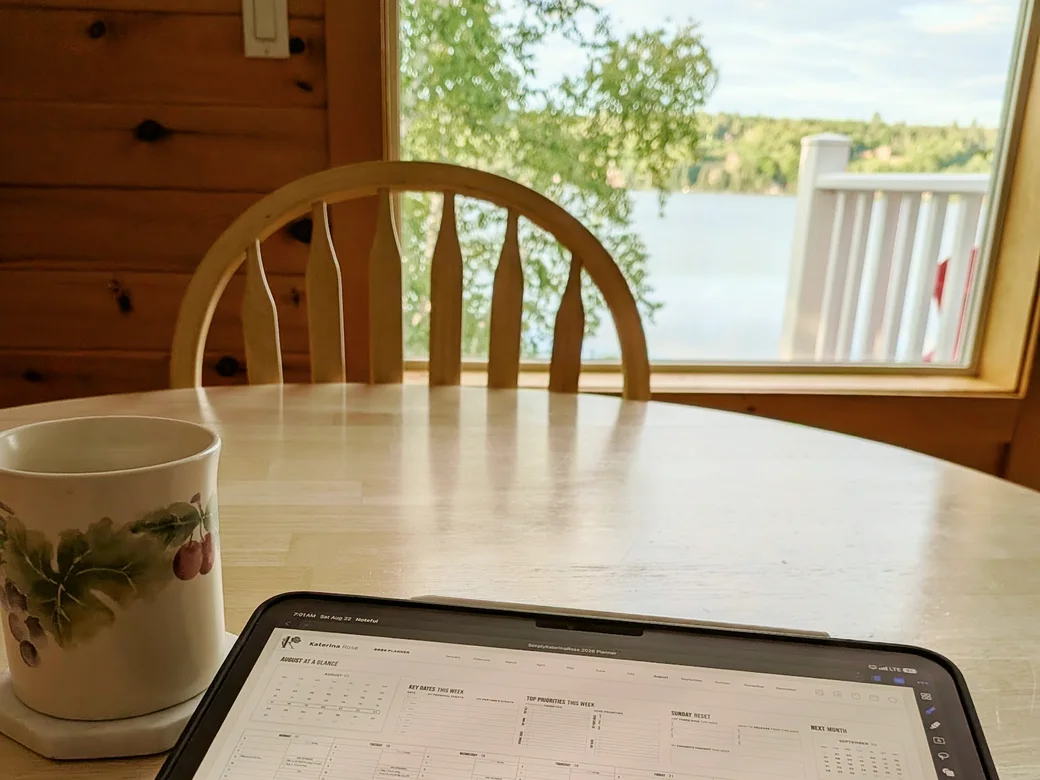
Nothing about the weekend was particularly transformative. I didn’t sit beside the lake and discover my life’s purpose. The moon did not reveal the secret to inner peace. No woodland creature arrived carrying a profound lesson about presence.
I just spent a couple of days paying attention to what was actually in front of me.
That was the difference.
Disconnecting wasn’t the absence of things that wanted my attention. All of those things still existed. It was choosing, for a while, not to react to each one simply because it had asked.
Instead, my attention went to the people around me. The next puzzle piece. The view from the trail. The moon over the water. Coffee that I got to drink while it was still hot.
The world did not stop asking things of me.
It just got quieter enough for me to choose what received an answer.

Everything was still there when I got home
When I got home Sunday, everything was still there.
The inbox. The renovation. The household list. The dozens of open loops that had managed to survive two days without my supervision.
So had the job boards. I found a bunch of roles worth applying to and sent the applications. Then Monday morning arrived with three automated rejection emails at 9 a.m. A fourth followed later, because apparently three at once wasn’t quite enough.
The weekend hadn’t changed any of it. It hadn’t cleared the list, resolved the uncertainty, or rewarded me for taking a break with some neat little sign that I had made the right choice.
That wasn't really the point.
For a couple of days, I wasn’t waiting for anything.
I wasn’t monitoring, refreshing, checking, or mentally trying to solve whatever came next.
I was just where I was.
I’m not about to throw my phone into a lake or become someone who preaches about digital detoxes. I like being connected. Most of us need to be.
But being reachable all the time doesn’t mean I have to be available to everything all the time.
There will always be another input. Another notification. Another problem that could use a plan. Another useful thing I could be doing.
Sometimes I can let it wait and choose what gets my attention instead.
Everything will still be there when I get home.