

My calendar changed rather abruptly this week.
I’m not going to dwell on why. What matters is what I did with it: I started looking at my own work with the same curiosity I usually bring to the systems I build for other people.
I’ve spent thirteen years moving through development, UX, Design Operations, and Product Operations. On paper, that can look like a series of career changes. I’ve had the “so, what do you actually do?” conversation more times than I can count, and I’ve never had a clean answer for it. The job titles keep changing. The industries keep changing. The scale keeps changing.
But this week, with my usual calendar suddenly cleared, I finally had time to lay all of it out and look at it honestly. And the thing is, it’s not a series of career changes. Not really.
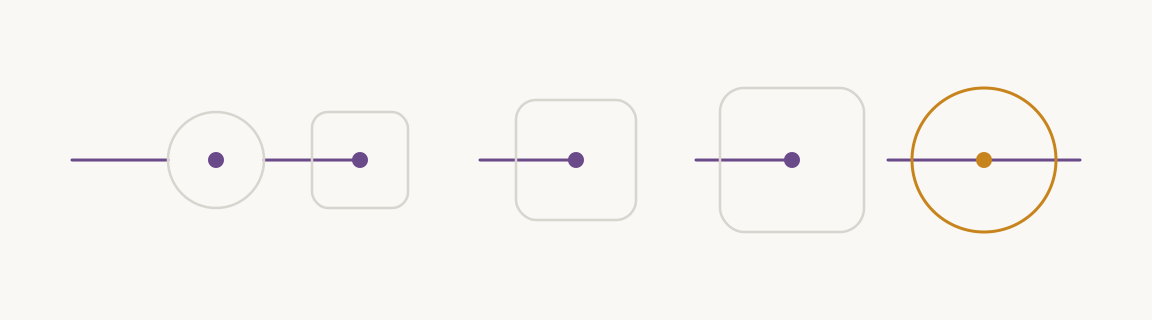
Understand where the friction actually lives, then build the system that removes it.
I’ve been solving the same problem the entire time.
In my early career, that friction was in the gap between what users needed and what they were given. I worked on that as a developer, then as a UX designer, because the tools changed but the problem didn’t. Later, the friction moved upstream. It wasn’t in the interface anymore; it was in how the teams behind the interface worked together, made decisions, and shipped. So I moved into Design Operations, and then Product Operations, because that’s where the friction had gone.
I didn’t plan this arc. I can see it now, but I wasn’t following a strategy. I was following the problem. Each time I got good enough at solving it in one context, I could see it showing up in the next one. And I kept going toward it, because that’s the work that actually interests me.
This week I’ve also been thinking about how AI fits into this. Not in the abstract, thought-leadership sense, but in the practical, daily sense: I’ve been refining how I use it in my own workflows, not only as a productivity tool, but as something to design systems around. Something to delegate to, supervise, and occasionally argue with.
I’m not wrapping this up with a grand takeaway. I’m still in the middle of it. But I will say this: if you’ve ever felt like your career doesn’t tell a straight story, it might be worth pausing long enough to look at the work itself, not the titles, not the industries, not the org charts. The work.
You might find a thread you didn’t know was there.